We congratulate Holy Family Academy, the winner of the Turks and Caicos National Museum’s fourth annual History and Cultural Heritage Quiz! Well done! Congratulations to Raymond Gardiner High School on their second place win and third consecutive win as a quiz finalist!
Thank you to the nine secondary schools for participating in the quiz, to the teachers, parents and students for their hard work that went into the preparation for participation in this quiz. It was a closely contested quiz with an exciting finish.
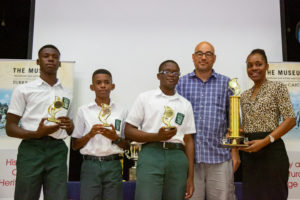
Davar Lewis -student, Cajair Davidson-student, Cameron Handfield-student, Dr. Michael Pateman , Ms. Stacie Ann Taylor – Teacher Raymond Gardiner High School)
Special thanks to our sponsors, Fortis TCI, interCaribbean Airways, TC Reef Fund, Grace Bay Car Rentals, United Taxi Alliance and the Departments of Education and Culture. We say thank you the Teacher’s Workshop facilitators, Quiz committee, Rachel Harvey, Drexler Smith, Brandon Handfield, Brenda Clare, Enid Capron Ripsaw Band and our dedicated volunteers.
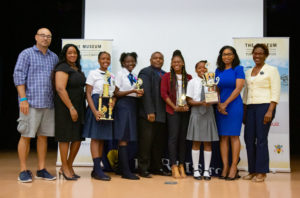
Dr. Michael Pateman – Director National Museum, Ms. Ludwina Fulford-Director Department of Culture, with winners Christian Jean, Ikera Stubbs, Nahshya Hinson and Mr. Edgar Howell- Director-Department of Education, Ms. Guilmese Gustave-teacher Holy Family Academy, Mrs. Ruth Forbes – Senior Vice – President of Fortis TCI Ltd., Candianne Williams, Museum Representative